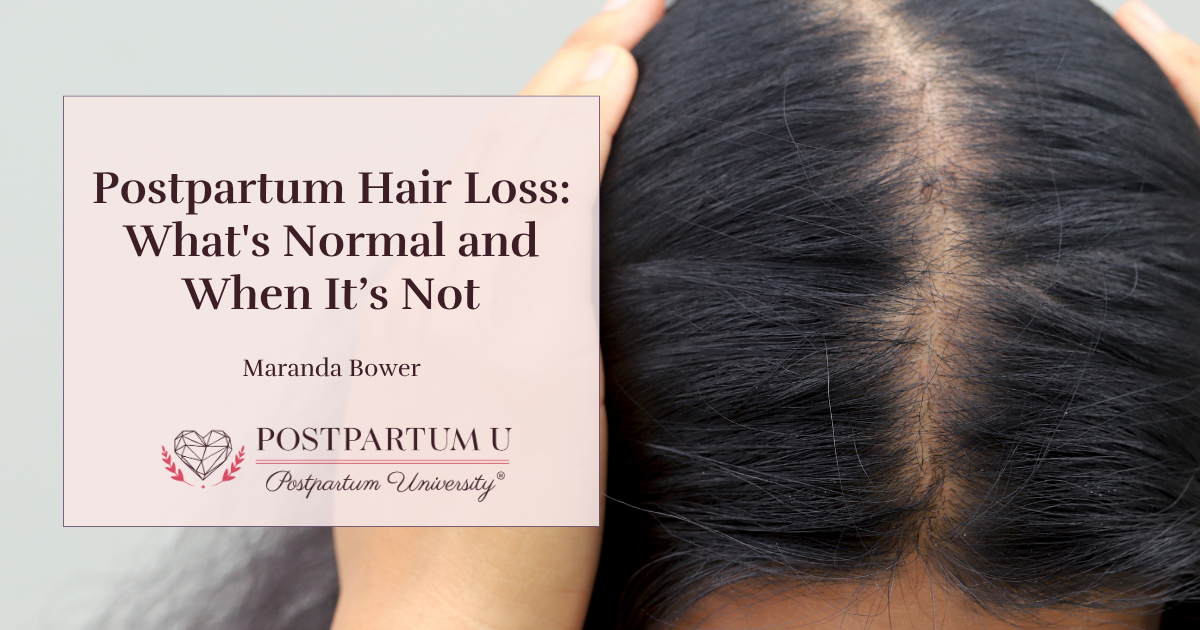


Somewhere between two and five months after birth, a woman stands in the shower, watches a fistful of hair go down the drain, and feels a very specific kind of fear. She searches it. She finds the same words everywhere: it's just hormones and it’s normal.
That answer isn't wrong but it’s strikingly incomplete.
And that gap is where thousands of women disappear.
Postpartum hair loss is common enough that “normal” has become the only word attached to it, full stop, no further questions. But the research doesn't actually support treating it as one uniform event. Reported rates of postpartum shedding range from roughly 40 percent to over 90 percent, depending on how and when women are asked (Hirose et al., 2023). That's not a narrow, predictable pattern. That's a wide spread of experience being flattened into a single reassurance.
There is a real, well-documented biological process behind postpartum hair loss. It has a mechanism, a timeline, and an expected resolution. There is also a second category of loss that gets filed under the exact same label, met with the exact same shrug, and left to run its course when it isn't running the course it's supposed to.
This article draws that line. What is actually happening to the hair follicle after birth. Where the normal pattern is expected to start and stop. And what it means when a woman's hair loss stops fitting that pattern — because at that point, “normal” isn't reassurance. It's a missed signal.
To understand how lingering hair loss fits into the broader picture of long-term physiological strain, read Why Postpartum Symptoms Can Appear Years Later: Why the Body Compensates Before It Collapses.
This article is original research synthesis by
Maranda Bower, founder of Postpartum University®.
Research originally published November, 2025.
You’re welcome to share excerpts or discuss these ideas publicly. When doing so, please credit the original work to Maranda Bower / Postpartum University® and link back to this article when possible.
To cite this article:
Bower M. Postpartum Hair Loss: What's Normal and When It’s Not. 2026. https://postpartumu.com/research/postpartum-hair-loss/
What Actually Happens During Postpartum Hair Loss
Hair doesn't grow continuously. Every follicle cycles through phases: a long growth phase (anagen), a brief transitional phase (catagen), and a resting phase (telogen), after which the hair sheds and the cycle restarts. At any given time, roughly 85 to 90 percent of scalp hair is in active growth, with the remainder resting or shedding.
Pregnancy disrupts this cycle in a specific, well-characterized way. Elevated estrogen extends the growth phase, holding hair in anagen longer than it would normally stay there. Fewer follicles enter the resting phase. Fewer hairs shed. This is why so many women describe their hair as thicker and fuller during pregnancy. It isn’t because new hair is being generated, but because hair that would ordinarily have already been shed isn’t actually shedding.
After birth, estrogen drops sharply. The follicles that had been held in an extended growth phase shift into telogen in large numbers, more or less simultaneously. Roughly two to three months later, that hair sheds and leaves the body at the same time. This is telogen effluvium: a synchronized release of hair that should have shed gradually over the preceding months, arriving all at once.
The timing is consistent enough to be mapped. In one of the more rigorous recent studies on the subject, shedding began at an average of 2.9 months, peaked around 5.1 months, and resolved by roughly 8.1 months (Hirose et al., 2023). Over 90 percent of the women in that study reported some degree of postpartum shedding.
This is the process that earns the word “normal.” It is expected. It is time-limited. And for most women, it resolves on its own.
The New Book from Postpartum University®
Everything You Know About Postpartum Is Wrong
Now available for pre-order! For every provider who's felt the ache of offering more in a system built for less. And for every mother who knew something was wrong long before anyone believed her.
Pre-Order on AmazonBut that same study found something else worth sitting with: the two strongest predictors of postpartum hair loss weren't just “having a baby.” They were extended breastfeeding duration and preterm labor (Hirose et al., 2023) — both of which point toward physiological load, not hormones acting in isolation. A synchronized estrogen drop is the trigger. It is not the whole explanation.
Where the Hormone-Only Story Breaks Down
The estrogen-drop model is important but it's frequently used to explain far more than it actually accounts for. It doesn't explain why some women lose noticeably more hair than others despite comparable hormonal shifts. It doesn't explain why the shedding continues well past the 8-12 month window that telogen effluvium is supposed to occupy. And it doesn't explain why hair texture changes — new curl patterns, new dryness, new breakage — show up in women whose estrogen has long since stabilized.
It's also worth noting that hormonal birth control, which suppresses ovulation by mimicking a pregnant-like hormonal state, is independently associated with hair shedding (Asghar et al., 2020). If elevated estrogen alone explained postpartum hair retention and loss, that relationship should run in a more predictable direction. It doesn't. Hormones are relevant, yes, but the evidence shows that hormones are one input into a larger system, not the entire system.
When hair loss is severe, prolonged past a year, or accompanied by other symptoms, the estrogen-drop explanation is usually still technically true and still functionally useless. Something else is driving the severity, and that something else is almost never investigated, because postpartum care doesn’t exist at this stage after birth.
Why Some Women Lose More Hair Than Others
Hair follicles are among the most metabolically active tissue in the body. They sit low on the list of priorities when the body is rationing resources — which is exactly what's happening in the months after birth, while tissue repair, milk production, and blood volume recovery are drawing on the same depleted reserves. When key nutrients are in short supply, follicles are some of the first tissue to be deprioritized, entering a resting and shedding phase to conserve resources elsewhere.
Iron Deficiency and Postpartum Hair Loss
Blood loss during birth, combined with pregnancy's own iron demands, leaves a substantial share of postpartum women with depleted iron stores. Postpartum anemia has been documented at high rates, particularly in the months immediately following delivery (Elmore, 2022)https://pubmed.ncbi.nlm.nih.gov/11518906/. Iron deficiency is one of the most consistently identified nutritional correlates of hair shedding outside of pregnancy, and there's no physiological reason that relationship would suspend itself simply because the iron loss happened to occur postpartum.
Zinc and Postpartum Hair Loss
Zinc is required for the activity of hundreds of enzymes, including several involved directly in hair follicle function and tissue repair. It's transferred to the baby throughout pregnancy and continues to be transferred through breast milk, at a rate that outpaces what most postpartum diets replace. Depletion is close to universal in the postpartum period. It is also almost never tested.
Selenium, Thyroid Function, and Hair Loss
The thyroid produces mostly T4, an inactive hormone that has to be converted into T3 (the active form) by selenium-dependent enzymes in peripheral (Bano, 2025). When selenium is depleted, that conversion slows. A woman can have “normal” TSH and T4 on standard labs and still have a functionally underactive thyroid, because the piece that actually matters (conversion) was never measured. Hair loss is a documented symptom of hypothyroid states, and thyroid hormone is required for normal follicle cycling.
Postpartum Thyroiditis and Hair Loss
This is the piece that gets missed most often, because its symptoms are the same ones every postpartum woman is told to expect anyway. Postpartum thyroiditis — a distinct autoimmune thyroid condition — affects an estimated 5 to 10 percent of postpartum women in the year after birth (Stagnaro-Green, 2012). Its hypothyroid phase produces fatigue, hair loss, low mood, and cold intolerance: a symptom list that is functionally identical to “normal new motherhood.” The distinguishing feature isn't the symptoms. It's the trajectory. Ordinary postpartum shedding tapers by 8-12 months. Thyroiditis-driven hair loss doesn't taper on its own; it continues or worsens until the underlying thyroid dysfunction is identified and addressed. (Please note: thyroid dysfunction is also a sign of major depletion. It is not a “normal” part of postpartum. It is not due to your thyroid being overworked in pregnancy.)
None of these are exotic. All of them are testable. None of them are routinely tested in a six-week postpartum visit built around a blood pressure check and a mood questionnaire.
When Postpartum Hair Loss Is No Longer Normal
There is a meaningful difference between hair loss that fits the expected pattern and hair loss that doesn't, and the difference is trackable without a lab.
Ordinary postpartum shedding starts around 2-3 months, peaks around 4-6 months, and is substantially resolved by 8-12 months (Hirose et al., 2023). It is a thinning spread evenly across the scalp, never localized to a specific patch or the hairline alone. It happens alongside an otherwise unremarkable recovery.
What falls outside that pattern: shedding that is still heavy at twelve months. Shedding that started later than expected or seems to be accelerating rather than tapering. Bald patches or hairline specific loss. Hair loss paired with fatigue that doesn't respond to rest, cold intolerance, unexplained weight changes, or mood changes that feel disproportionate to circumstances. Hair loss in a mother who is also showing signs of iron depletion — dizziness, pale skin, exhaustion that doesn't track with sleep.
Any one of these, on its own, is worth a real conversation with a provider — ferritin, a full thyroid panel including antibodies, not just TSH. Together, they are not “just hormones.” They are a body that is signaling depletion in the clearest way it has available.
Why This Gets Missed
This isn't a story about individual providers failing individual mothers. It's a story about a system that was never built to look at the whole picture.
Hair loss, when it's investigated at all, tends to go to dermatology. Fatigue goes to primary care. Mood changes go to mental health. Thyroid concerns, if they're raised, go to endocrinology — usually after months of the other three specialties turning up nothing conclusive. Each provider is looking at one piece of a pattern that only makes sense when it's viewed as a whole. And the postpartum visit that's supposed to catch all of it — the six-week check — was designed around obstetric recovery, not systemic nutritional or endocrine status.
So the woman is told, correctly, that some hair loss is normal. What she isn't told is where normal ends, because nobody on her care team is looking at the full timeline, the full symptom picture, or the labs that would actually distinguish ordinary shedding from something that needs support.
What This Article Is Not Claiming
This isn't an argument that all postpartum hair loss is a sign of pathology. Most of it isn't. The synchronized shedding that shows up two to five months after birth and resolves within a year is expected, biologically explainable, and not, on its own, evidence that anything has gone wrong.
This also isn't a case for panic, self-diagnosis, or assuming the worst about every strand in the shower drain. It's a case for precision. “Some hair loss is normal” and “your hair loss is normal” are two different claims, and only one of them can be assessed without actually looking at a woman's timeline, her labs, and the rest of what her body is telling her.
And this is not caused by having a baby. It is not caused by breastfeeding. Pregnancy, birth, and lactation are normal physiological processes with known, predictable costs — not pathology, and not the source of the problem. The loss that falls outside the expected pattern is not caused by motherhood itself. It is caused by a body that was never given what those processes required to be replenished. The variable was never the baby. The variable was whether her needs were met.
The Real Question
The question was never whether postpartum hair loss is normal. Some of it clearly is.
The question is whether the word “normal” is being used as a finding or as a dismissal — whether it's the conclusion of an assessment, or the reason one was never done.
Most postpartum hair loss will resolve on its own. But “most” is not “all,” and a woman whose hair loss doesn't fit the expected timeline deserves more than a shrug and a reminder that this happens to everyone. She deserves to have her iron checked. Her thyroid checked completely (not just TSH). Her nutrition assessed for what pregnancy, birth, and breastfeeding actually cost her. Her body is not malfunctioning. It's been depleted, and it's telling her exactly that, in the clearest language it has.
This is the level of pattern recognition taught inside The Postpartum Body — how to read what a mother's body is actually communicating, instead of defaulting to the nearest available explanation. Whether you're a mother trying to understand your own postpartum experience, or a provider who has felt the limits of “it's just hormones” in your own practice, this is where that gap gets closed.
Learn More About The Postpartum: thepostpartumbody.com.
References
- Asghar F, Shamim N, Farooque U, Sheikh H, Aqeel R. Telogen Effluvium: A Review of the Literature. Cureus. 2020 May 27;12(5):e8320. doi: 10.7759/cureus.8320. PMID: 32607303; PMCID: PMC7320655.
- Bano I, Hassan MF, Kieliszek M. A Comprehensive Review of Selenium as a Key Regulator in Thyroid Health. Biol Trace Elem Res. 2025 Dec;203(12):6466-6480. doi: 10.1007/s12011-025-04653-7. Epub 2025 May 13. PMID: 40358914; PMCID: PMC12672807.
- Elmore C, Ellis J. Screening, Treatment, and Monitoring of Iron Deficiency Anemia in Pregnancy and Postpartum. J Midwifery Womens Health. 2022 May;67(3):321-331. doi: 10.1111/jmwh.13370. Epub 2022 Jun 1. PMID: 35642737.
- Hirose M, Nakamura T, Mori K, et al. Investigation of exacerbating factors for postpartum hair loss: a questionnaire-based cross-sectional study. Int J Womens Dermatol. 2023;9(3). https://pmc.ncbi.nlm.nih.gov/articles/PMC10846762/
- Stagnaro-Green A. Approach to the patient with postpartum thyroiditis. J Clin Endocrinol Metab. 2012;97(2):334-342. https://pubmed.ncbi.nlm.nih.gov/22312089/
This article is original research synthesis by
Maranda Bower, founder of Postpartum University®.
This research was originally published November, 2025.
You’re welcome to share excerpts or discuss these ideas publicly. When doing so, please credit the original work to Maranda Bower / Postpartum University® and link back to this article when possible.
To cite this article:
Bower M. Postpartum Hair Loss: What's Normal and When It’s Not. 2026. https://postpartumu.com/research/postpartum-hair-loss/