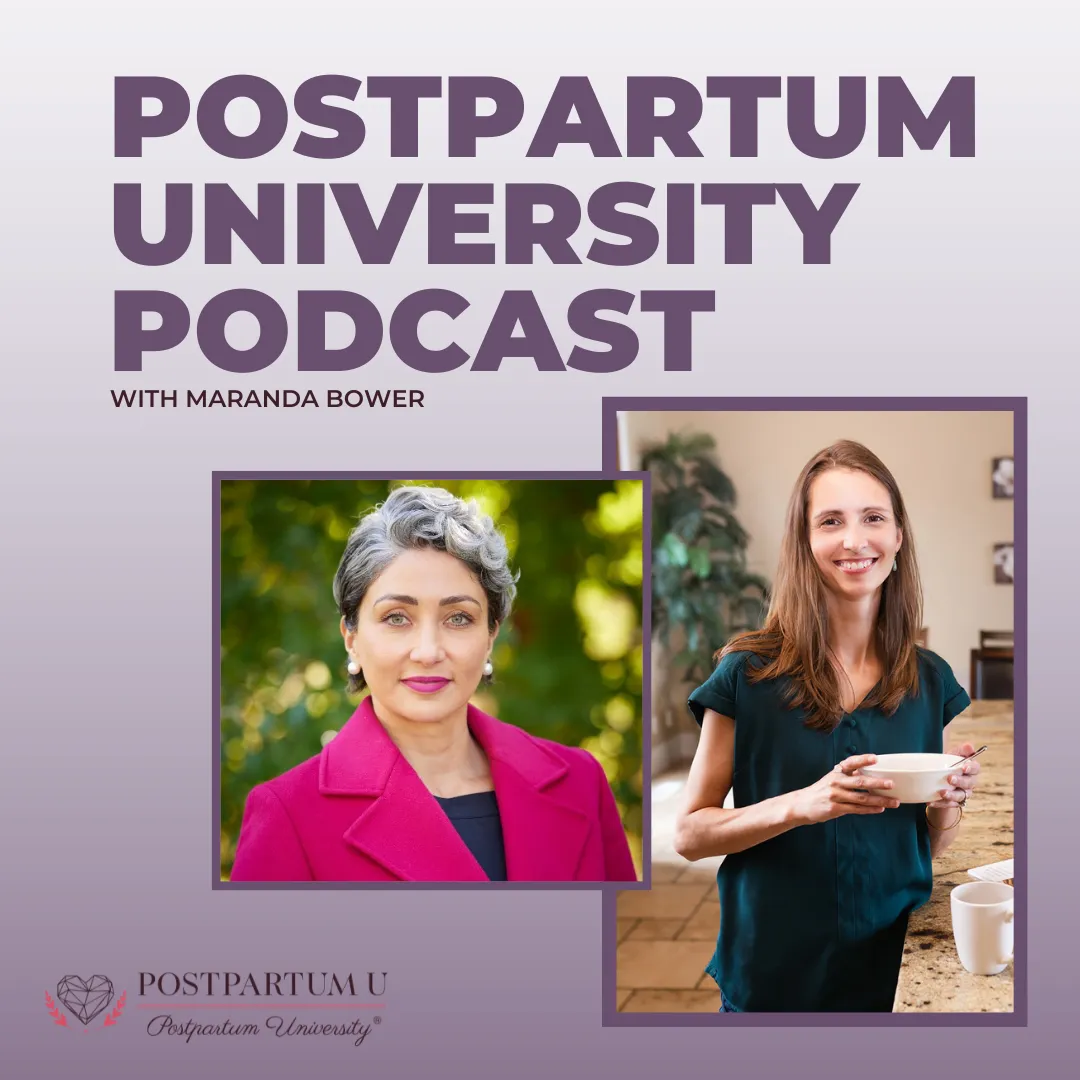
Welcome to the Postpartum University podcast where we support you and your provider in understanding the science, the art, and the sacredness of healing after birth. I’m Maranda Bower, your host, your Postpartum Nutrition Specialist, and homesteading mom with four wild kids. It’s time to get you the holistic, whole-body healing that works.
Maranda: Hello, everyone. Welcome to the postpartum university podcast. Maranda Bower, your host, and I am so ecstatic to share with you today’s guest. This is Dr. Sarah Buckley, the Dr. Sarah Buckley. And she is a family physician. She’s got obstetric chairing. She’s also a PhD candidate at the University of Queensland. where her research is focused on oxytocin and the atomic nervous system and labor and birth. I’m so excited to have this conversation with you, along with the impacts of intervention. So we’re gonna talk about that. She’s also a bestselling author, a contributor to professional text research, books, films, and so much more. If you are in the birth world and the postpartum space, you know, Sarah Buckley. And if you don’t, you will at the end of this interview because she’s just so amazing.
Maranda: Sarah, welcome.
Sarah: Thanks so much, Maranda. It’s beautiful to be talking with you on opposite sides of the world almost. I know Alaska and New Zealand, right?
Maranda: Australia, actually. I’m in Brisbane, the north part of Australia.
Sarah: That’s beautiful. That’s beautiful.
Maranda: So I always start this show with a question, how did you come… into this work? Can you touch a bit on your personal story here? Because I know it’s so reflective of the work that you are doing around the world.
Sarah: Yes, good question. So I’m medically trained and in fact my, I come from a long line of medically trained. My father was actually an obstetrician. My grandfather was a family doctor in a small town in New Zealand called Whangarei. And he would travel out on horseback. to attend women giving birth. So it’s kind of in my blood a bit. But I guess the most pivotal experience for me was giving birth to my own four children and I’d learned all these kind of things in medical school and then I did some postgraduate training in GP family physician obstetrics. But when I came to have my own babies goodness me, the experience was so different for me. what I’d learned about, from what I’d expected, and that positive feelings. I call it ecstatic birth. I could feel that it actually changed my brain in the process, particularly with my first baby. Out of that, I thought, “Whoa, what is this? How is this like day and night? What happened to me?” That became my by quest, really. What is it that can happen in labor and birth? I was inspired by people like Michelle O’Donnell to look at the hormones of labor and birth. And ultimately I had three more very positive ecstatic births. I had all my babies at home, but that doesn’t mean to say you can’t have an ecstatic birth in hospital or in any setting really. So yeah, what I learned was that there’s a physiology, a normal biological processes that happen during labor and birth, I call it mother nature. nature superb design and that’s what I had experienced myself and seen a lot of other women experience as well and that took me into writing about birth, ecstatic birth was my first article for Mothering Magazine back in 2002 and then really building on all these hormones of labor and birth and then in 2015 I read a report called Hormonal Physiology of Childbearing which you may be familiar with. It’s a free download. But what was curious about that or illuminating about that was not what we knew, but what we didn’t know. There’s so much we don’t know about the hormones, about the impacts of intervention, about what that means for mothers and babies. And so I started a PhD in 2016, working on specifically oxytocin. And I’ve had the incredible privilege of working with one of the world experts in this area. a Swedish woman called Kirsten Uvna Smoberg. So we’ve collaborated on papers with some other European researchers and really dug deep and we’re still digging deep and it really is still, you know, my inspiration is that I want to understand it and I want to understand that as I call them hormonal gaps and then what we can do when these interventions are needed so that every mother, baby, father and family gets the best possible stuff.
Maranda: And this is why I feel like I relate to you so much. I’ve had four babies all born at home. And that’s really how I got involved into this field myself. I wasn’t there in the very beginning. It kind of drew me in because I noticed all of the changes and the shifts that were happening in my body. And I was so curious as to what in the world was going on because nobody had told me anything. anything about these changes. We all know your body changes, but it felt so much deeper than what was being conveyed and what we were actually talking about. It was almost a taboo topic. I couldn’t even bring it up with my other mom friends. It was like, yeah, this thing happens, but I don’t know what to call it. I don’t know what it is. So I’m so grateful that you are doing this work. Can you share a little bit more about your work in the oxytocin arena? What does that look like? What are you exploring and discovering?
Sarah: One of the reasons it’s been oxytocin is because this hormone has more research, not just inside reproduction but outside reproduction. So what I’ve been doing in my PhD is working with Kirsten and other European colleagues looking at what we call systematic reviews. So that’s where you go to all the evidence or the studies that have been published and you find all of them through a systematic process. And then you summarize them and make some general pronouncements about what does it mean. So my first systematic review and I’ll give you the links Maranda so you can post them there. We looked at oxytocin measurements, oxytocin levels in physiological labor and birth as I said by nature’s superb design. How does it work? What do the numbers tell us? Thank you to all the women who had their blood taken and in labor to have those studies done. And then the second paper we looked at was oxytocin levels during breastfeeding. And our intention was to look at oxytocin release and breastfeeding in relation to what happened in labor and birth. But we found very few studies on that, but we could find some really interesting, so we included those in our second paper. But back to you, was even more interesting really was some of the studies that have been done taking samples during women breastfeeding and seeing what happened to their oxytocin levels, what happened to their stress, and it really is, you know, beautiful evidence about that, their overall effects of oxytocin and how it really is, you know, a new mother’s best friend, you know, during breastfeeding, their release of oxytocin. So that happens then, you know, reduces cortisol, reduces stress, activates reward and pleasure centers. So it kind of, I guess it takes oxytocin and labor and birth to the next level. What happens postpartum with oxytocin and how does it help, you know, not just women and children, we’re not just talking humans here, we’re actually talking every mammalian species because oxytocin is actually a quintessential mammalian hormone and mammals, the genus of mammals or the group of mammals means mammary glands we suckle our young. So we have oxytocin there’s some magical hormone in common amongst all of our mammalian cousins as well and it has the same effect and it basically as I said contributes to mother nature’s superb design and it’s not just about labor and birth and I guess this is the bigger picture view you know, having a baby or giving birth amongst our mammalian cousins is not just about, you know, a live baby and a live mother in the end. It’s about species survival. It’s about the long term survival. It’s about the evolutionary perspective that has mothers and babies survive the birth and thrive and go on to have more offspring who survive and thrive. So oxytocin feeds into all of that, not just by optimising the outcomes of labor and birth, but through its release during breastfeeding, as we just discussed, during skin-disc and contact, during social interactions between mothers and offspring of all mammalian species that really contributes to species survival and long-term beneficial outcomes. It’s why we’re all here today. And just another thing to say about it is that oxytocin, as I said, is that it’s really important for us to be able to make sure that we’re know, there’s some research inside reproduction, but it really is the kind of flavour of the decade you could say outside reproduction. There’s so much research on oxytocin in social situations, pretty much any, you know, disease or mental illness you could think about is being researched with oxytocin at the moment because it has these common connecting effects within the brain. And it’s not just that, but it’s also a social whole. and humans like all other mammals are social creatures so oxytocin contributes to this as a we say social affiliative hormone so it’s not just about that most powerful and necessary social bond between a mother and her baby all mammals we’re talking here but it’s also about social behaviors and later on in life and we suspect but we don’t know for sure it hasn’t really been studied in a lot of detail that when the oxytocin system is optimised for mothers and offspring that that will optimise social interactions, social outcomes in the longer term because we know and this is kind of looking far ahead really that one of the predictors of long-term health and wellbeing is social connectedness. You know people that are a bigger circle of social connectedness, let’s live longer, have better health and wellbeing. well-being. So oxytocin is kind of cradle to grave really as a beneficial system for humans and all our mammalian cousins.
Maranda: This is mind-blowing because I feel like we can go in about a million different directions right here. That is absolutely incredible, everything that you are sharing. And you talk a lot about oxytocin in one of the groundbreaking reports that you had created called hormonal physiology of childbearing. And that report really provides some scientific evidence and details about these processes that you’re speaking of and labor and birth and postpartum, including the impacts of common maternity care interventions within these systems. I mean, this is an extensive research report. Can you tell us a little bit more about this hormonal physiology? What does that mean? And how does that oxytocin play into that?
Sarah: Yes, well, it’s a big question. So hormonal physiology is really what I’m talking about, Mother Nature’s superb design. How are hormones designed to facilitate the processes of labor and birth? And as I say in the report, it’s not just childbirth, it’s childbearing, it’s about the long-term relationship between mothers and babies, the long-term health and well-being of both of them. So hormonal physiology is a structure within which we can look at those questions, like how do the different hormones play into labor and birth, how even how do the different hormone systems get ready for labor and birth, that’s a big question too. I recommend chapter two on that report. It’s a 2015 report, but Chapter 2 is still updated for another publication recently. And still, you know, the surprising thing is, you know, we don’t actually know what causes the onset of labor and birth in humans. You know, if I could tell you the answer to that question, I would get a Nobel Prize. We, you know, in some other species, it does vary a little bit. But what actually causes the onset of labor and birth in women and babies, we don’t know. So it’s kind of ironic that we’re stepping over that with high rates of induction, high rates of pre-labor caesarean, where no labor happens at all when we don’t even understand the processes and the importance of it, you know, the optimal readiness of the mother, the optimal readiness of the baby. And for example, in relation to the oxytocin system, the optimal readiness includes increases in what we call oxytocin receptors, and the uterus I’ll come back to that point, but basically a whole lot of changes that make the uterus ready for those increases in oxytocin that happens and they lead up to labor and birth. And these processes are so effective and efficient that, and this is from our 2019 study of physiology of oxytocin levels and physiological labor and birth and fat when a woman goes into into labor, her oxytocin levels are not that high. And the reason is because all of these pre-labor changes that happen that make her uterus incredibly sensitive to those moderate amounts of oxytocin that get released. So a lot of preparation is put into the onset of labor and birth and all mammals. I describe it a bit like a royal wedding. There’s all these preparations that happen beforehand and, you know, if we… you know, if the royal people came and expected it to start a week beforehand, it wouldn’t be the same. All those last minute preparations wouldn’t happen a day before, even an hour before ride. And this is what we know from human studies, from animal studies as well, even those last hours before the physiological onset of labor and birth, because some other nature’s putting in those finer little touches to make sure that it goes as easily as possible. because that’s the best shot at not just survival of mothers and babies, but species survival, evolutionary survival.
Maranda: And you speak so beautifully about oxytocin in this report and well beyond. And you talk about beta endorphins and noneproneprin and prolactin and all of these different processes and postpartum and well beyond. The production production of breast milk, bonding and attachment and the pleasure and reward system. And this is where my interest has really peaked. And so I would love to talk about these pleasure and reward systems in motherhood. What is this? What’s happening here? I just feel like we need to have a conversation around this.
Sarah: Yes, good question. So if we go back to our mammalian heritage and you think about other mammals, dogs, cats, elephants, they don’t go to classes to learn how to take care of their babies, right? It all happens through the processes of labor and birth. In fact, the processes of labor and birth trigger the mothering behaviors. There’s mothering circuits in the brain, slightly different in every species, because every species has slightly different mothering behavior. You know, some species like cats and rats, you know, a caching species that put their babies in into little nests. So they’re mothering behaviors to carry their babies and do this thing we call archback nursing where the mother curls into a C shape to take care of their babies and allow them to suckle and give body warmth. And of course, there’s other, you know, hoofed animals where the baby gets up straight away and runs. So there’s different parts, different mothering behaviors, but all of those are switched on by oxytocin. We could call it a mothering hormone as well. And of course, to do these things, obviously it has to rise in the brain. So just going back to some kind of basic oxytocin physiology. So it is a brain hormone primarily. It’s made in the hypothalamus, the kind of middle layers of the brain. And then it’s stored in the pituitary gland, which is kind of a little bit downhill from there.
Sarah: And then it’s released from the pituitary gland into the bloodstream. So all of these studies I’m talking about, obviously, measured oxytocin in the bloodstream, but that’s only one facet of it. It gets into the bloodstream, it causes the rhythmic or facilitates, we say the rhythmic contractions of labor, but it’s doing an equally important job in the brain because it’s released not just from the brain into the blood, but within the brain. And this is where it has all those magic effects that we’re talking about, switching on the maternal circuits, as they’re sometimes called, triggering maternal behavior. And part of that maternal behavior is a powerful activation of the reward and pleasure centers, the dopamine circuits in the brain. So all the time that oxytocin in labor is being released to facilitate the rhythmic contractions of labor, it’s also being released within the brain. And it’s doing all these critical central effects of switching on the reward and pleasure centers so that when the new mother and again we’re talking all mammals here meets her babies for the first time she’s got this powerful activation of those parts of her brain and then she has the sensations from her newborns, the smell of them, the taste of them, most mammals lick their newborn babies, the touch of them and all of those things get we could say fired and wired with that powerful activation of the reward and pleasure centers so basically the mother goes “oh these are my babies or babies They’re a source of pleasure and reward to me.”
And I say it’s like the best first date ever. You know, you can’t help but fall. The mother’s can’t help that we would say fall in love, but we could say form a strong bond with their babies. And that bond will be the source of survival of those babies because the mother’s going to have to do all kinds of things to take care of the baby. She has to, you know, stop her previous behavior. She has to lie still. She has to get food for them. She has to protect them from predators. All is a big job for all mammals, not just women. So the reward and pleasure center activation is really what motivates and rewards that mothering behavior in all mammals. So it’s really important that that brain oxytocin gets released during labor and birth. And it not only gets released, but it gets generously released. we could say, the processes of labor and birth. And I just want to explain one way that the peripheral, the blood levels, get linked up with the brain levels. So there’s a circuit that’s been called the Ferguson reflex.
Anyone out there that studied childbirth as a midwife, maybe a doula, labor and delivery nurse, physiology, it’s basically, it’s a feedback loop. And it was discovered to do with… animals in the pushing stage of labor. Basically what happens is as the baby descends, it stimulates sensations in the lower vagina, the pelvic floor, the cervix, and that sends a specific nerve signal back to the brain. It’s a specific sensory signal. And when that information gets back to the brain of those sensations, the brain during later and birth. this is quite unique, is triggered to release more oxytocin. So the brain releases more oxytocin, it goes in the bloodstream, travels to the uterus, causes a stronger contraction, more powerful sensations for the mother at that point, more sensory feedback. So it’s a positive feedback loop. And this is how oxytocin levels don’t just increase in labor, I’d say they snowball. It’s like start small becomes bigger and bigger. And it basically makes labor virtually unstoppable.
Yeah, you might have experienced this yourself or the listeners here that there’s a point in labor where nothing’s going to stop it, right? And there’s also a point in early labor where the snowball small and it is quite easily disrupted. So this positive feedback loop, the Ferguson reflex happens not just at the pushing pushing stage to help the mother to push her babies out with those strong contractions and those big peaks of oxytocin. It also happens all the way through labor. So this means that every time the mother has a contraction and she has those sensations, it’s not just triggering more oxytocin to her uterus, it’s actually triggering more oxytocin to her brain. And oxytocin has a whole lot of impacts on the brain.
We talk about the maternal circuits being being activated. We talked about the pleasure and reward systems, but also it has pain relieving effects and that’s going to be useful in labor and birthright. And that means that the stronger the contractions, the more this positive feedback, the furgues and reflex, the faster that loop is going, the stronger the contractions, the more pain relief she has, the more calm and connection that’s an oxytocin effect as well. The more the parasympathetic nervous system that we’re talking about. and growth, the calming system gets turned on because oxytocin helps to, it’s in the brain, it’s also a neuromodulator. It modulates a whole lot of systems in the brain, which is why its effects are so beneficial outside of reproduction. But if we go back to labor and birth at the same time, these peaks of oxytocin in the brain have calming, connecting, pain-relieving effects. They actually reduce inflammation. They switch on antioxidant effects.
Sarah: A whole lot of beneficial effects are happening for that birthing mother or mammals in the brain as the processes of labor unfold. And then we get to that inevitable stage where things are pretty intense, where the pushing happens. And that’s when we get these much more intense contractions, much more intense sensations. So we get large amounts of oxytocin being released, which is what helps to birth the babies quickly and easily. And that’s really important, not just for human mothers, but if we think about in evolutionary terms for 99.9999% of human evolution, we’ve given birth in the wild, like our mammalian cousins. And it’s critical in the wild that labor is as efficient as possible because mothers and babies are vulnerable to predators. They’re behaving strangely, they’re making strange noises, there’s all the smells of the blood and the amniotic fluid and the baby. So the efficiency of birth is actually built into the processes of labor and birth and this Ferguson, this positive feedback loop is a part of that. It makes labor as efficient as possible and it makes the pushing stages efficient as possible but it also means that during labor and birth it’s not just what’s happening in the uterus, it’s also what’s happening in the brain. So the mother’s getting these peaks of oxytocin happening in her brain and powerfully activating all of those things we talked about, the pain relieving effects, the calming connecting pain relief effects, switching on the parasympathetic system, which switches down the sympathetic system, the vital flight system as well, and then also switching on those maternal circuits and the reward and pleasure centers. So that, as I said, the best first date ever is going to happen when the baby or babies are born for that unique, that really unique hormonal situation that the mother will be in. It’s called an early sensitive period because things that happen at that time, that first hour after birth, the golden hour, the magical hour, things can happen then that won’t happen again subsequently. It really is, as I said, Mother Nature’s best shot at species survival because these peaks of oxytocin switch on the mother’s reward and pleasure centers. We could say she falls in love with her baby. That’s Mother Nature’s superb design. Any or species that they bond with their baby and they’ll be motivated to take care of their baby. In human women, we’ve talked about mammals, but this is equally true in women as well. And part of Mother Nature’s superb design is not just these oxytocin peaks at birth, but the baby comes out, babies, and they skin to skin with the mother. That’s what every mammalian newborn does. They know how to fund their way to the mother’s nipple, to suckle, to be in contact with the mother, skin to skin contact, we call it. It’s funny, actually, when I was at medical school, we learned all these reflexes that newborn babies have, human newborn babies, they have a stepping reflex, they have a a nipple reflex where they can find the nipple, you know, they can smell the nipple. And we actually learned, this is groundbreaking, that human babies can actually do what every mammalian baby could do, which is find the nipple and self-attach. You might have seen videos of this called the breast crawl. So every human baby can do that, find the nipple, self-attach. And those early interactions in that one to two hours after birth, haven’t even more powerful effect on the mother’s oxytocin system because this is from research that my colleague Kirsten Uvnes-Moberg and her colleagues did in Sweden. And when we measure oxytocin or those positive feedback loops, the Ferguson reflex, etc., but then in the hours of the interactions between mothers and babies, they can be double, they can even be up to 10 times higher. So I’ll imagine the powerful reward and pleasure center activation that’s happening in that hour after birth. And that’s sometimes I say, you know, when a mother gives birth, she graduates as a mother. And that hour after birth is a postgraduate education where mother nature superb design is that mothers and babies are not disturbed. They’re skin to skin, the opportunity for the mother to release this oxytocin, which has all those effects we’re talking about. about but also the physical effects of contracting her uterus are basically saving her life from postpartum hemorrhage and also has another beneficial we could say life-saving effect for the baby which is that it opens up the blood vessels we say vasodilates the chest of the new mother and her chest literally pulses heat to a newborn baby and that’s why, I’m sure you’ve heard of this why new babies when they’re skin to skin on the mother are much warmer than anything we can put on them, any hat we can put on them.
Maranda: We talked about that on Facebook, didn’t we?
Sarah: Because of this superb design of the mother’s heat keeping the baby warm.
Maranda: If you’re a birth and postpartum professional who wants to give the families you serve some solid holistic evidence-based information, regarding nutrition, repletion, and nourishing your body after baby. This is for you. I have 18 beautiful pages in a handout form that is completely free. Free full guide to nutrition, completion, common misconceptions, supplement support, favorite recipes, 30 healthy and quick snacks, and so many more. You can download your book. free collection with handouts at postpartumu, that’s the letter u.com/handouts.
Maranda: It’s almost as if you are telling me, and I don’t know how any other way to summarize all of this juicy information, but it’s like the mother’s body and the body is perfectly designed to take care of our children, to grow our children, to grow our children. children and to take care of them.
Sarah: That’s exactly right and if you think about these millions of years of evolution you know there weren’t any hats or or rugs or anything to wrap the baby and it was the mother’s body body heat just like every other mammal that keeps the baby warm and you know in our evolutionary context there’s nowhere else for the baby to be you know if you put the baby down and turned around the baby wouldn’t be there when you look back again yeah this so many predators out there in the wild, so we are designed, and our babies know we’re designed, the mothers and babies to be in skin-to-skin contact. The babies cry when they’re taken away from the mother. They actually did a study on that. It’s a bit sad, but they identified that human babies like other mammalian babies have a separation distress call, which means that it’s actually not even audible to the ear, and most species, it’s sub – you know, we can’t hear it as humans, but the babies will cry when they’re taken away from the mother. So it’s the bit sad we had to do a study to show that, isn’t it, Maranda? But, you know, we’re mammals and we are superbly designed to do the whole thing without any accessories, you know. And I’m thinking about the world in which we labor and birth in right now. And everything that you had described is nothing like what you know. we’re doing today is nothing like what we used to do before. And there’s so many common maternity care interventions that are really negatively impacting these hormonal systems,
Sarah: Yes? That’s right. That’s right. And just going just an example, what we just talked about is the skin to skin contact between mothers and babies. And I’ll share a story actually because I trained in hospitals, of course, and then I actually attended home births for a while. And the first home birth I attended, the baby came out, you know, and I was trained as a doctor. It was my responsibility for the health and well-being of the baby. So I was going to like take the baby away and test their heart rate and make sure they’re okay. And the mother looked at me like, “What are you doing with my baby?” And of course, I’m like, “Oh, that’s right. The baby belongs to the mother, not to me.” me as the medical professional. So, you know, I think we take the baby away, then the mother doesn’t have those opportunities to release her own oxytocin. We’ve caused a hormonal gap. And then what do we have to do is give us synthetic oxytocin or some other, we say uteronic, uterin contracting drug to stop it from bleeding because she can’t release her own oxytocin. And hormonal gaps in labor and birth are kind of along those lines as well. You know, one of the hormonal gaps at the very beginning is when we go to hospital because again if we think about evolution, if we think even about more recent cultural practices, you know, the top aim of care for women and labor in most cultures is that the woman feels safe, that she’s supported, you know, and we haven’t taken that into modern maternity care system and we put it into a completely fine system. environment, you know, that she’s not familiar with with strange smells, strange noises, strange people.
And that is not kind to the oxytocin system, to the part of the brain, the limbic system that we kind of sink down into during labor and birth. And, you know, you may be able to relate to this people listening that, you know, women often are laboring really nicely at home and then they hop in the car to go to hospital and everything slows down or stops because we’re not in that safe place. It’s so critical that the laboring female, all mammals, feel safe, you know, private safe and unobserved is what I say, that’s how we’ve done it through millennia. And, you know, when we go into a situation where we don’t have those feelings, then our oxytocin levels go down, our stress hormones go up and labric can slow down or even stop, yeah. So just a little hint and to fill in that hormonal gap because I’m sure we’ll get on to that later. But we talked about the snowball of labor and it’s much more disruptible in those early stages. And especially for first-time mothers who haven’t been through all these sort of hormonal blueprint previously. So my little hint there is, you know, have someone with you that can facilitate, smooth that flow into hospital and help you to feel safe, your own doula, a midwife. And the other hint is wait at home until… until labor, the snowball of labor is so big it’s unstoppable because at that stage, you know, if you if you disrupt labor or move someone into a strange situation or trigger her stress system, what will often happen is it will actually trigger the process of labor and birth.
Sarah: And again, if you think about birthing in the wild, you know, in the beginning of labor, a threat turns up a predator turns up, it’s much better to shut labor down, the mother can run away, find a safe place, labor can resume. But if that stress happens at the end of labor where the snowball is so big it’s unstoppable, it makes much more sense to give birth to the baby quickly and easily and then run away and that’s what can happen at the end of labor. It’s called the fetus ejection reflex. So that’s another hand if you’re birthing in a hospital, wait till your snowball is so big it’s unstoppable before you. you go in. So that’s a couple of kind of environmental gaps you could say, but there’s also gaps in relation to common interventions. So one of the most common one, I know this is particularly true in the US, you have very high rates of epidural use and that’s come happening all over the world as well. Our rate at the moment is a little over 30%. I think it’s more than 70 or 80% in the US.
And, you know, all of these interventions, like going to hospital, like taking the baby away, they can all be life-saving in some situations. Sometimes babies need that help to breathe after birth. Sometimes you need to go to hospital ’cause you’re having a problem. So it’s not the intervention itself, it’s the hormonal gap that it creates. So an epidural can be a very beneficial intervention in labor at birth. Sometimes women are very stressed and labor can be a very intense process as you and I know and probably– all the listeners know, you know, it’s not a walk in the park. So, but the problem is, and going back to our positive feedback loop, if you remember what we talked about, that the sensations of labor feedback by a specific nerve pathway to the brain and tell the brain to release oxytocin.
And then that gives more oxytocin release, more sensation. So the problems with epidurals is they’re so effective at inhibiting pain. Having an epidural is a bit like going to your dentist when they inject a local anesthetic next to your dental nerve and everything goes numb. An epidural is injected into the spine next to those nerves that supply this sensation to your uterus and everything goes numb. And so there’s no signals coming. We’re numbing those nerves. We’re blocking those nerves, literally that supply, that feedback, the sensory part of our feedback loop. So what happens is oxytocin levels start to go down and they go down further. And if we compare oxytocin levels at birth or soon after birth with an epidural and not, they’re really significantly reduced, um, depending on the study, maybe 50% lower. So, and they don’t go up, you know, with the positive feedback loop has levels rise and labor, but with an epidural levels stay the same. And of course, because. can only measure them in the bloodstream whereas a lot of the things we’re talking about are actually happening in the brain. I just want to mention something I didn’t mention before of these effects of oxytocin in the brain which is one of the effects that it has and this is really interesting is that it actually changes the new mother’s personality.
There are quite a few studies have been done about that doing a personality inventory after birth and comparing it to to non-pregnant women. And women become more sociable, they become less tense, less physical tense, more relaxed. On all of those things, we think to do with those oxytocin peaks in labor and birth. And one of the reasons we think that is because when women have an epigel and lose those peaks in the brain because we’ve slowed down this feedback loop or even stopped it, they don’t get those personality changes. changes. So it kind of all fits in. And what that means is if you have an epidural you may not get. In fact, you almost certainly don’t get that activation of the pleasure and reward centers. And all of these hormones, not just oxytocin as I talk about in their report, you know, put women into this older state of consciousness during labor and birth.
You know, it’s a very intense experience. And Mother Nature gives us all the help that she can. And we could say, “A pudding is a good thing.” into this altered state. You know, it’s been described as going to labor and going to another planet. I’ve heard it said that one of the Native American tribes says that women in labor go out to the stars to collect the soul of their baby and bring it back. So that’s what’s happening in labor as well through all these changes in the brain. And, you know, with an epidural, you don’t get those life changes in the brain. You’re more kind of normal. in lab But you’re not out in the stars.
Sarah: So, there’s quite a big hormonal gap there as far as epidurals are concerned. And I think that feeds into some of the more difficulty that women can have breastfeeding after an epidural because it’s disrupted. It’s created a hormonal gap in their oxytocin system and probably other systems as well. And the good news is I don’t want to leave you with the bad news is we can fill in those hormones gaps. And the way to fill in those hormonal gaps basically two things: skin to skin and breastfeeding. Because skin to skin, as I mentioned, releases oxytocin for the mother. We haven’t talked about the baby; that’s a whole nother conversation. But it releases skin to skin for the mother and helps to fill in that hormonal gap. Suckling, as I mentioned early on, releases oxytocin for the mother, including in her brain. So those things will help to fill in the those hormonal gaps. But I want to say one more thing about hormonal gaps, which is that everything that we’ve been saying is that that moment of the onset of labor and birth, mother’s body is absolutely 100% ready. Yeah, we’re talking about normal four term labor and birth. Everything’s in place. And as I said, she doesn’t need, for example, a big amount of oxytocin to trigger her contractions because she’s got all this ready and ready. So I mentioned also that that time after birth, we call an early sensitive period because of the readiness. So that hormonal, when that doesn’t happen, not only does the mother miss the oxytocin at that time, if we talk about EPG, or she’s also missed the readiness, that fertile place that oxytocin was going to land to induce all those changes in her. So if you are filling in hormonal gaps, if you have, you know, as I said, good reasons for interventions, certainly there are, you need to not only do skin to skin and breastfeeding, but you need to do it for a long time. For example, in that study on personality, women did fill in that hormonal gap. Their personality did change after about four months of exclusive breastfeeding. Yeah. So it takes a long time. I mean, I’ll just share another anecdote because of course everything we’ve talked about is gonna be different when a woman has a caesarean and particularly a pre-labor caesarean elective, whatever you wanna call it, where there’s no labor at all. So none of that readiness, a big gap in readiness, a big hormonal gap in the hormones of labor and birth. So mothers in a completely different hormonal state to a woman who’s been through labor and birth, the baby’s in a different hormonal state. So a big hormonal gap. And I’ll just share an anecdote. It was actually a story I read in the birthing magazine and this mama had had two natural births. The third one she needed a pre-labor caesarean for reasons of wellbeing for her baby. And she said when I got my baby after the birth, my baby felt different and definitely the baby’s in a different hormonal state. Definitely, she’s in a different hormonal state as well. And she said, “My instinct was to do skin to skin with my baby.” And she said, “After three days of skin to skin, my baby felt the same.” Now, that’s kind of an example of the hormonal gap, how to fill it in, and really the extra work that you’re going to need to do to fill in that hormonal gap. If you’ve missed that, what I call window of opportunity.
Maranda: I wonder if there are other ways in which we can increase that too. Has there ever been any studies on how being taken care of, of maybe our partners supporting us in that oxytocin release or nutrition and the hormone gap filling that in? Is there anything in regard to how we can increase that even more, including skin to skin obviously and breastfeeding?
Sarah: Those are good questions. I’ve never seen any research on nutrition and oxytocin. I mean, all of these hormones, hormones are built from molecules, are built from factors for things that we eat and drink. So, I imagine that nutrition would, you know, if we have good nutrition that will benefit our, all of our hormonal physiology and importantly, all of our recuperation from labor and birth as well. You know, all those huge amount of nutrition we’ve donated to our baby that we have to replenish as well.
Sarah: So, I’m a big fan of nutrition, not just in pregnancy and postpartum, but preconception, you know. If we want to grow healthy, healthy plants in our garden, you know, what we put in before the soil, the condition of the soil makes much more difference than what we put in later. So, all of nutrition, I’m a big fan of that. It’s what we’re made of, right? The molecules, the foods that we take in are very important. Even if I haven’t seen specific research on that, but it’s certainly a good, an important topic. I think what you’re saying about care taking is really important as well because, you know, oxytocin is a social hormone, you know. If we’re isolated, it’s likely our oxytocin system is gonna contract. If we feel taken care of, our oxytocin system is likely gonna flourish, you know, like friendly supportive care and labor and birth, for example, optimizes the oxytocin system. It’s one of the reasons why women are healthy, their babies with a midwife, you know, or a doula, a supportive birth companion tend to have a better time in labor and birth because that support, that feeling safe, all of that optimizes the oxytocin system for labor and birth and means that those women need fewer interventions. I’m more satisfied with the birth and all of those things. And there’s no reason to think that that wouldn’t happen in the postpartum period as well. And, you know, again, if we look back at traditional cultures, you know, they support the woman, not just in labor and birth, but they know how critical that, we say, often 40 days, six weeks, those traditions that have the woman and her baby taken tenderly cared for in that time after the birth, massage daily, kept warm, fed, nourishing food. I mean, all of those things are going to feed into the mother’s care taking systems. And I just want to mention, mention an animal study. We talked a little bit about lifelong health and well-being as part of the intention of mother nature’s superb design that we’re talking about. So this was an interesting animal study where they took rats and that bred rats to be genetically give low levels of maternal care or genetically give high levels of maternal care. So they took all the worst caring mothers and they bred their babies on and on and on. So this was a breeding process. And then they did a cross fostering program where they took the babies that were bred to give low levels of maternal care and they fostered them with mothers who were bred to give high levels of maternal care and vice versa. And then they looked at what care those females who’d been cared for gave to their own babies. And what was really interesting was it wasn’t the selective breeding that determined the levels of care, it was the care that those babies received. So even if they’d been bred to give low levels of maternal care, if they were received a lot of maternal care and in rats that means as I mentioned archback nursing, the mother’s being available, the body heat being available and lots of licking. So the more those babies received that, the more they gave that when they had their own babies. And they actually found in these studies, there’s quite a long series of studies that I’m quoting here, they actually found that that affected the oxytocin system and the interactions between the estrogen system and the oxytocin system. So those mothers produced more oxytocin receptors in response to estrogen. Basically means when they were pregnant, they had more oxytocin receptors, which means that they would be more motivated to, the oxytocin system would work better in their own mothering. So there’s definitely, you know, there’s transgenerational things, but also I guess what I’m saying is also that the care that we give to new mothers can have that long-term impact as well, not just socially, but also actually in terms of brain structure.
Maranda: I feel like we can sit here and have a conversation for hours and hours, Sarah. This has been an absolutely incredible interview and I just appreciate your wealth of knowledge and we are gonna actually be including many of the studies that you’re a part of and what we’re speaking on today in the show notes. So definitely just tune in there. Where can people find you and your work so they can explore these topics deeper?
Sarah: Yeah, so my website is SarahBuckley.com and I really recommend you go to the blogs because I’ve got some, the positive feedback loop we’re talking about, it’s kind of hard to explain but there’s some nice visualizations, some diagrams in that. If you look under my epichural blogs, there’s just a whole blog about the physiology, the oxytocin physiology paper and there’s more blogs coming as we do more research as well. So go to my website, look up the blogs, you can sign up for my newsletter as well. And if you also on the opening page, if you click all the science, you’ll find links to the studies that I’ve been involved with for my PhD, which are most of them are open access so you can download them and read them for free.
Maranda: I appreciate you so, so much. Thank you for all the work that you are doing in the world. Thank you for coming here and sharing everything that you have done today. Dr. Sarah Buckley, everyone, thank you.
Sarah: Thanks, Maranda. It’s been a pleasure.
Maranda: Love this episode. Let us know by leaving an amazing review. Your support is everything. Want more? Head over to postpartumu.com. That’s postpartum, the letteru.com, and explore how we support moms like you in holistic, whole the world healing that’s specific for the unique needs of mamas in the years postpartum. See you there.